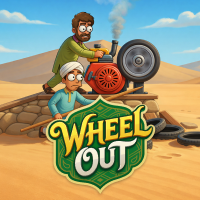
Wheel Out Game Icon

Wheel Out

Set your stake, press SPIN, and observe the wheel race through desert hazards

AUTO
Resolution
INSTANT
Rounds
96.5%
96.5%
Desert wheel game from INOUT GAMES Experience Wheel Out

Track Element Categories

Each symbol on the track serves a distinct mechanical role in shaping your round's final outcome

Adders

+1 / +2 / +5 / +10

LINEAR BOOSTS
+1, +2, +5, +10 LEARN MORE
  • Builds your running total incrementally
  • Adds fixed numeric value on contact
  • Forms the baseline of most rounds
View Details
Hazards

Pigeon Cut

PENALTY
/2 PIGEONS LEARN MORE
  • Divides running total by two instantly
  • Cannot be avoided or canceled
  • Strikes without player input
Understand Risk

How Wheel Out Operates: The One-Action Model

Wheel Out delivers a fundamentally different instant-game structure by removing all mid-round player decisions. The entire experience hinges on a single committed action: pressing SPIN. Before that moment, you configure your stake and optionally select a visual speed preference—Slow, Normal, Fast, or Ultra—to control how quickly the round unfolds on screen. Once SPIN is activated, the wheel embarks on its journey across the desert track without further input. You do not steer the wheel left or right to dodge obstacles, and critically, there is no cash-out button to click when you feel the total is favorable. The wheel travels its predetermined path, interacting with every track element it encounters, until it reaches either a safe stopping point or a terminal hazard that ends the round immediately.

This automatic resolution model creates a distinct rhythm. Tension builds not from split-second timing decisions but from pure observation. As the wheel rolls forward, you watch fixed adders like +5 or +10 incrementally raise the running total displayed on screen. When a multiplier zone—x2, x3, x4, or x5—is struck, that total scales exponentially in an instant. Conversely, the notorious /2 Pigeons penalty can appear without warning, slicing your accumulated value in half. Walls and pits represent absolute endpoints: contact means immediate round failure with zero return. The Ladder Holder symbol offers rare salvation, catching a doomed wheel and relaunching it with the current total preserved. Because none of these outcomes can be manually influenced after SPIN, each round plays out as a self-contained story you witness rather than control.

Understanding this operational framework is crucial. Wheel Out is not a steering game, nor does it feature the manual cash-out mechanic common in traditional crash-style formats. It is an automatic wheel-and-track instant game where your agency is exercised entirely before launch. The speed setting adjusts only the animation tempo, not the mechanical outcome. Once the wheel is in motion, the result is already locked into the track's layout, and your role shifts entirely to observer.

Game Specifications

Attribute Value
Developer INOUT GAMES
Format Wheel-and-Track Instant
Control Model Automatic (No Steering, No Manual Cash-Out)
Theoretical RTP 96.5%
96.5% Steering
Not Available Manual Cash-Out
Not Available (Automatic Resolution Only) Speed Selection
Slow / Normal / Fast / Ultra (visual pacing only) Platform Access

Depends on operator or host environment

What the 96.5% RTP Actually Means

Wheel Out reports a theoretical Return to Player (RTP) of 96.5%, a figure provided by INOUT GAMES and calculated across millions of simulated automatic rounds. This statistic is often misunderstood, so clarity is essential. The 96.5% does not describe what will happen in your next ten spins, nor does it promise that you will recover ninety-six and a half percent of your stake during a single session. Instead, it reflects the long-term mathematical structure of the game: over an enormous sample size, the algorithm is designed to return 96.5% of all wagered amounts to players collectively, while retaining 3.5% as the house edge. This is a theoretical average, not a session-level prediction.

In practical terms, Wheel Out exhibits high variance. The track layout ensures that outcomes swing dramatically. You may experience multiple consecutive rounds where the wheel strikes a wall or plunges into a pit within seconds, yielding zero return each time. Equally, a fortunate path might thread through several adders and culminate in an x4 or x5 multiplier, producing a sudden large result. The automatic nature of the game intensifies this volatility: because you cannot manually exit mid-round to lock in a modest gain, every spin is exposed to the full range of track hazards and bonuses until a natural conclusion is reached. The /2 Pigeons can devastate a strong total moments before a safe landing, while the Petarda Crow introduces abrupt visual chaos. The 96.5% RTP is a macroscopic truth about the game's design, not a microscopic guarantee for your immediate experience.

Mechanical Elements Explained

No Mid-Round Control

After SPIN is pressed, the wheel completes its journey automatically. There is no steering input and no manual cash-out option. The round resolves entirely on its own, shifting the experience from active control to focused observation of the unfolding track events.

Incremental Adders

Scattered across the track are symbols marked +1, +2, +5, and +10. When the wheel makes contact with these elements, the corresponding value is added directly to your running total. These fixed adders form the steady foundation of most successful rounds, building value linearly.

Multiplier Zones

For dramatic escalation, the wheel must encounter multiplier symbols: x2, x3, x4, or x5. These do not add a fixed amount; instead, they multiply your current running total by the stated factor. A well-timed multiplier after a series of adders can transform a modest total into a significant result instantly.

/2 Pigeons Penalty

Among the most feared track elements is the /2 Pigeons symbol. Contact with this hazard immediately halves your running total. It is a harsh, unavoidable penalty that can appear at any point during the wheel's travel, drastically reducing accumulated value in a single instant.

Walls and Pits

Certain track sections contain terminal hazards: solid walls and deep pits. If the wheel collides with a wall or falls into a pit, the round ends immediately with total loss. These are absolute failure points, representing the ultimate risk inherent in the automatic travel system.

Ladder Holder Rescue

The Ladder Holder is a rare protective element. If the wheel's trajectory appears doomed, encountering this symbol can save the round. It preserves your current running total and relaunches the wheel, offering a second chance when a terminal hazard seemed inevitable.

Visual Theme and Cultural Roots

Wheel Out's distinctive aesthetic draws heavily from its viral origins in India and Pakistan, where the format first gained widespread attention. The game is set against a stark desert landscape, with the wheel racing across a dusty, sun-scorched track. This visual identity is not merely decorative—it establishes a gritty, grounded atmosphere that contrasts sharply with the bright, neon-saturated interfaces common in many instant games. The desert setting reinforces the sense of isolation and irreversibility: once the wheel is launched, it is alone on the track, subject entirely to the hazards and bonuses it encounters. The visual clarity of each symbol—whether a numeric adder, a multiplier marker, or the ominous /2 Pigeons—ensures that players can instantly parse the mechanical consequence of each collision.

Every visual and auditory cue in Wheel Out is engineered to compensate for the absence of manual control. The trajectory line that traces the wheel's path provides constant spatial orientation, while particle effects and sound bursts mark each adder, multiplier, or penalty strike. The Petarda Crow introduces sudden visual disruption, heightening tension even though it does not change the core total. INOUT GAMES has optimized the entire interface for mobile browsers, ensuring a vertical, single-handed layout that keeps the action centered and uncluttered. This design philosophy—pairing a culturally resonant desert motif with mechanically transparent symbols—creates an immersive observation experience that remains legible and engaging across rapid-fire automatic rounds.

Round Structure Breakdown

Configuration Stage

  • Choose your stake amount for the upcoming round
  • Optionally adjust the speed (Slow, Normal, Fast, Ultra)
  • Review settings—no changes possible after launch
  • Press SPIN to commit and initiate the automatic sequence

Automatic Travel Stage

  • Wheel departs and begins moving across the desert track
  • Running total updates instantly with each adder or multiplier hit
  • Penalties like /2 Pigeons can strike at any moment
  • Round concludes at a safe landing zone or terminal hazard

Developer Background

Wheel Out is developed by INOUT GAMES, the studio behind this distinctive automatic wheel-and-track format. The game removes steering and manual cash-out mechanics entirely, focusing player attention on the pre-launch stake decision and the subsequent automatic resolution. This design choice creates a streamlined, observation-driven instant game that has resonated strongly in mobile-first markets.

Common Questions About Wheel Out

Can I control the wheel after pressing SPIN?
No. Once SPIN is pressed, the wheel travels automatically along the track. There is no steering mechanism and no manual cash-out button. The round resolves entirely on its own based on the track elements encountered.
What does the 96.5% RTP represent?
The 96.5% RTP is a theoretical long-term average calculated over millions of rounds. It describes the game's mathematical structure, not a guarantee for any single session or spin. Individual results will vary significantly due to the high-variance track design.
Which company created Wheel Out?
Wheel Out was developed by INOUT GAMES.
What happens when the wheel hits /2 Pigeons?
The /2 Pigeons symbol is a penalty hazard. When the wheel collides with it, your current running total is immediately divided by two, significantly reducing accumulated value in that instant.
Does the speed setting change my odds?
No. The speed setting (Slow, Normal, Fast, Ultra) controls only the visual animation tempo. It does not alter the mechanical outcome, introduce steering, or add a manual cash-out option.
What is the result of hitting a wall?
Hitting a wall is a terminal event. The round ends immediately, and all accumulated value is lost, resulting in a zero return for that spin.

Start Your First Wheel Out Round

Automatic resolution. 96.5% theoretical RTP. One-action gameplay.

Play Wheel Out

18+ only. Set limits and play responsibly.